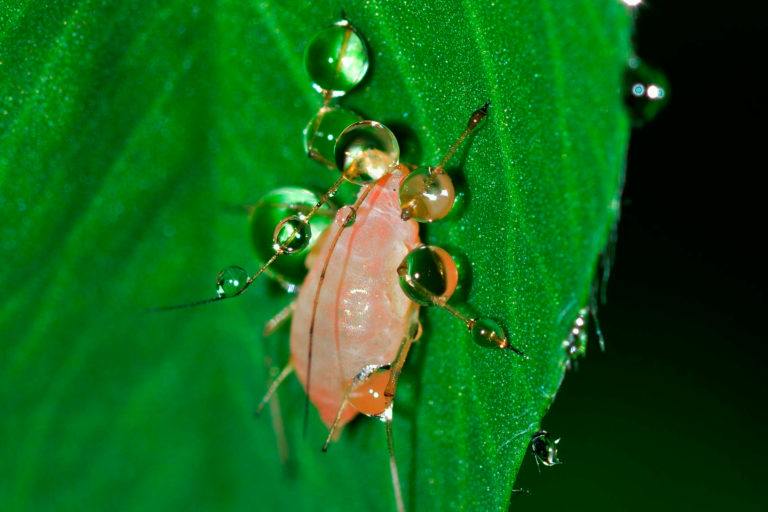
If you’re a gardener — flowers, vegetables, or otherwise — you are engaged in constant battle. You have weeds constantly trying to invade your territory. Weather tends to not always cooperate with your goals. And pests such as aphids will take a big bite out of your plants, shrubs, trees, and flowers –unless you stop them.
Aphids are the cause for many issues. They are the ones that create “honeydew” that can create a sticky film on your car’s windshield, patio furniture, or lawn. Aphids are the cause of many holes you might find in the leaves of plants that you are trying to keep alive. In short, aphids are an adversary for any gardener, homeowner, or grower of any type.
Aphids are sneaky and inconspicuous little beasts. They can show up, breed like crazy and completely destroy your flowers, vegetables, and even trees before you ever know there’s a problem.
There are many species and colors of aphids. They come in shades of green, red, brown, black, and yellow, and almost all have fat little pear-shaped bodies with several little tubes poking up out of the back end called cornicles. The green peach, potato, and melon aphids are among the most destructive of all aphids.
Aphids are usually named for the type of plant that they like to devour. In addition to potato, peach, and melon aphids, you will see people refer to bean aphids, cabbage aphids, etc. Nearly every vegetable or desirable plant has an aphid associated with it.
Aphids feed by piercing plants and sucking their juices. In doing so, they can transmit viruses that cause yellowing, curling, and distorted growth. Aphids also secrete a sticky substance called honeydew that often results in colonization by an ugly, sooty black fungus.
Aphids tend to congregate in a “hot spot”, a plant or two where they decide to take over. Instead of having a couple aphids on many plants, you will often see dozens of aphids on a single plant. That is how they are able to do the most damage.
The following are suggestions to help keep your gardens and plants safe and healthy.
Best Methods of Aphid Control
Frequent Inspection.
Catch them early. One “colonizer” can produce up to 80 offspring in as little as a week and is capable of doing so several times. Slowly walk through your garden several times a week, paying close attention to the undersides of leaves. Also check for aphids on newly purchased plants and transplants.
Just because you don’t see aphids on a few plants, don’t stop looking. As I mentioned earlier, aphids will often group up on one plant, making it the target for the entire colony.
Don’t over-fertilize.
Aphids prefer the new growth that is found in abundance in overly fertilized plants. Use only slow-release fertilizers. It is also a good idea to grow plants inside or under a cover until they are large enough to be a little more tolerant of pests.
One a plant is established, or a tree or perennial is well into the growing season, the risk of aphids decreases.
Spray with water.
A strong spray of water is an effective way to dislodge aphids from your plants. Most dislodged aphids will be unable to return to the plant. Think of yourself as a fireman keeping the opposition at bay with a huge fire hose. Only the opposition are tiny aphids, and all you really need is a garden hose.
The Bug Blaster is a hose attachment that works great for this. It is about 30 inches long and attaches to any type of garden hose. You can find it here on Amazon.
Home remedy for aphids.
You can kill aphids by spraying, especially under the leaves, with a solution of 2 tsp mild dish or laundry soap to a bottle of lukewarm water. The soap washes off the aphid’s protective waxy coating and causes dehydration. You can also mix three parts lukewarm water to one part vegetable or horticultural oil and a couple drops of dish soap. This mixture can be sprayed on to clog the respiratory spiracles of aphids. Spray once a week, taking turns between solutions. If using these solutions on food plants, be sure to wash them before eating. If using the oil solution, don’t spray on very hot and sunny days, as the oil can magnify the sun and possibly harm the plant.
Prune away colonies.
Aphids maintain the right to assemble. If you see a section of the plant containing aphids galore, snip it off and dispose of it. It doesn’t cure the problem, but it will slow the advance while giving other methods time to work.
Just be sure that your pruning is done at a point during the growing season that won’t harm the plant, tree, or shrub. Each plant has a different ideal time for pruning.
Also, be sure that you are pruning the plant in a place that will not hurt it and will make it stronger. If you just start hacking away without being thoughtful about your pruning cut, you could actually damage it.
Best Natural Aphid Control
Diatomaceous Earth.
This powder (food grade only!) is a natural insecticide safe for people and pets. Scatter around the garden and plants. You can get a 10 lb bag from Amazon for a decent price.
Neem Oil.
This oil is extracted from the seeds and fruits of an Indian evergreen and is used for repelling aphids without bothering beneficial insects such as ladybugs and bees. We like that it is bee-safe, as that is a major goal for any possible solution to aphids.
If you decide to use neem oil, be careful with your application. Even though neem oil is a naturally-occurring oil, it is recommended that you keep your exposure low. Wear gloves when applying it, and be sure to not ingest or inhale any of the oil as you are applying it.
We like the neem oil produced by Dyna-Gro, specifically made for outdoor home and patio use. Find it here on Amazon.
Yellow traps.
A yellow glass filled with water and a couple drops of soap to break water tension will lure aphids to it and cause them to drown. A yellow sheet of paper or tag board with a sticky substance such as double-sided tape on it also works for trapping aphids.
Biological Aphid Control
Ladybugs and lacewings are both highly effective predators of aphids.
These insects can easily be purchased live from many online vendors or lured to your yard using Safer Ladybug Lures. Keep ladybugs in the neighborhood by supplying them with a ladybug house (yes, that’s a real thing).
Lacewings are another enemy of aphids, and you can often see them on a warm summer evening. The nearly-transparent green creatures are not bad to have around.
Some beetles are able to hunt and keep aphids at bay, but the exact type will vary based on your location. There are many types of beetles.
Finally, wasps are a natural enemy of aphids…. but then again, wasps are no fun either. We did an entire piece on how to keep them away!
Wrens are also known to eat aphids.
Wrens are a lovely, small birds that are abundant in many parts of the world. They have a strong, loud sound and enjoy feeding on aphids. Accommodate these birds by placing houses in trees.
Aphid Insecticides & Sprays
Getting rid of aphids, if you play it smart, does not have to be a terrible ordeal. There are about a million and a half products available that kill aphids. We encourage you to apply sparingly, though, as so many of these chemicals are harmful to bees. The last thing we want you to do is to get rid of the aphids, but also the valuable bees.
The most common and effective types are IGRs, insecticidal soaps and oils, and pyrethrins. IGRs, or insect growth regulators, can work in several ways. They can mimic juvenile hormones so the aphid doesn’t reach sexual maturity, they can interfere with the production of chitin for the exoskeleton, and they can interfere with the process of molting. Azatin, Enstar AQ, Neemix and Preclude are all effective IGRs.
If you want to use something a little less harsh for controlling aphids, you may wish to look into insecticidal soaps and oils such as Safer Insecticidal Soap (which you can get at Amazon), Bon-neem Insecticidal Soap or any horticultural oil. These products are sprayed directly onto plants and aphids and work by trapping and suffocating, washing away the aphid’s protective waxy coating or by altering the permeability and structure of the cell membranes. This can cause the contents of cells to leak out, dehydrating the aphid. Pyrethrins are another type of aphid treatment that are commonly found in sprays. Pyrethrins are an extract of the chrysanthemum flower. Synthetic and equally effective forms are called pyrethroids. The brand Safer uses these in their insecticidal soaps. Bonide, Schultz and Pyola are other good brands. So, now you know how to get rid of aphids. Hop to it!
