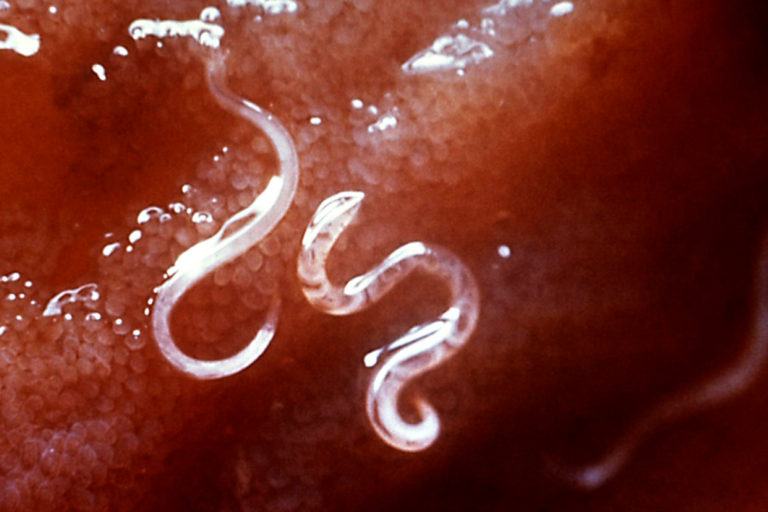
I can’t tell you I’ve ever suffered from a hookworm infection. In fact, almost 70% of the people who may be infected won’t be able to tell you they suffered because most people infected with hookworm are asymptomatic. Hookworms can infect people in two ways. The type of hookworm that infects humans will gain entrance to the body through the skin, usually the foot, where it begins its migration. The type of hookworm that infects dogs can also cause a skin infection in humans called cutaneous larva migrans, but may never develop into adulthood. There’s only one type of hookworm that has evolved into a human infective parasite, which will develop into adulthood and reproduce.
Thankfully, the hookworm that infects humans cannot survive in any climates other than tropical or subtropical. A certain amount of rainfall, as well as temperature are required before hookworm eggs can hatch and develop into the larval stage where it is possible for them to penetrate the skin and begin their migration through the body toward the intestines. If you suspect a hookworm infection it’s best to get it treated immediately. Serious cases of infection can lead to anemia caused by the hookworm’s thirst for iron, which it gets by voracious consumption of blood through the lining of the intestines. If you want to know how to prevent or treat a hookworm infection, the following information will definitely help.
Hookworm Symptoms
- Ground itch (itchy feet)
- Slight fever
- Coughing caused by larval migration through the lungs
- Wheezing caused by larval migration through the lungs
- Discomfort in the abdomen
- Any symptom associated with anemia
Hookworm Symptoms in Pets
- Dirt eating
- Over-eating or capricious appetite (not regular, but spontaneous)
- Digested blood in the stool
- Poor coat
- Weight loss
Best Prevention Techniques and Treatment of Hookworm
Wear Shoes
Wear shoes, especially if you’re traveling in tropical, subtropical or developing countries. Hookworms reproduce by laying eggs which are then expelled from the body during defecation. Once the eggs reach dirt, they begin a maturation process and develop into a larva that lies in wait for an unsuspecting person or animal to walk on them or lay down on them. The larva then penetrates the foot and begins it’s migration to the intestines. If you want to get rid of hookworm or prevent a hookworm infection, start wearing shoes.
De-Worm Your Dog
De-worming your dog is a good way to prevent a hookworm infection in both dogs and humans. Though it’s true that the canine hookworm cannot develop into an adult hookworm in the gut of a human, it can cause a nasty rash. De-worming your dog is the best way to prevent a rash caused by hookworm. You may also want to clean thoroughly any area where your dog has defecated recently or most regularly. The fecal matter left by a dog with a hookworm infection is most contagious and should be removed immediately. You may want to try dusting the area with pyrethrin (a common pesticide).
Mebendazole
Mebendazole is one of the three most common hookworm medications prescribed today. It’s commercial brand name is Vermox, and it may be administered in one of two ways. Vermox may be taken as a one time dose of 500mg or taken as 100mg twice a day for three days. If hookworm isn’t gone in 3-4 weeks, a second dose may be required. Mebendazole is usually administered only to humans.
Albendazole
Albendazole is the second most common hookworm treatment prescribed by physicians these days. Its commercial brand name is Albenza, but the generic formulas are becoming more commonly prescribed at a reduced cost. It is usually taken as a 400mg dose only once, but for children it is often taken in 200mg doses for three days and then repeated after three weeks to ensure that the hookworm infection is absolutely cured. Hookworms can cause serious problems in small children and the elderly, not the least of which is anemia.
Pyrantel Pamoate
Pyrantel pamoate is used in both humans and pets, and is regarded by veterinarians as one of the most effective de-wormers on the market. Its commercial brand name is Antiminth or Pin-X (which you can get at Amazon). It is also used to cure pinworms. For human patients, the recommended dose is 11mg once a day for three days. For pets (dogs and cats), one dose a week repeated over the course of three weeks should be a sufficient treatment to interrupt the lifecycle and return your pet’s health to normal. Our veterinarian prefers Nemex.
Natural & Organic Hookworm Treatments
Natural Treatments
Natural treatments that contain wormwood, goldenseal, and black walnut are usually quite effective in pets, but work more slowly than the solutions provided by Western medicine. As I mentioned in “how to get rid of worms”, the active ingredient in many natural worm treatments is wormwood extract, a powerful organic de-wormer.
Garlic
Garlic, an otherwise innocuous seasoning, is a blessing in disguise. Fresh Garlic cloves act as antiviral, antifungal, and antibacterial agents, and are often used by alternative medicine practitioners to treat parasites, like worms. Allicin, the active compound in Garlic, is used to cure giardia, pinworms, roundworms, tapeworms, and hookworms.
Diatomaceous Earth
Food grade diatomaceous earth, as I’ve mentioned in “get rid of worms”, is a great substance with which to naturally deworm your pets, and yourself if necessary. Food grade diatomaceous earth comes from fossilized algae that somehow kill intestinal parasites when ingested. You can get a 10 lb bag of diatomaceous earth from Amazon for a decent price.
Recommended dosages are as follows:
- Cats = 1 teaspoon
- Kittens = 1/1 teaspoon
- Dogs = 1-2 tablespoons
- Puppies = 1/2 tablespoon