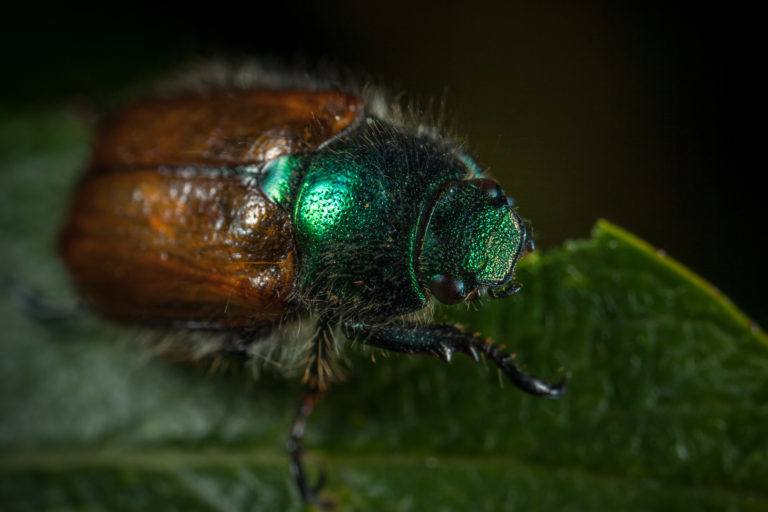
From the land of the rising sun comes a pest worse than Aibo the robotic dog, worse than tactical RPGs that have a story that makes no sense, even worse than formulaic Anime: Japanese Beetles. We’ve all heard the urban myth about Piranha and how they can strip a cow down to the bone in minutes. Well, the Japanese Beetle isn’t an urban myth, and when they congregate, and congregate they will, in sufficient numbers they can destroy thousands of dollars worth of landscaping in days. Japanese Beetles are one of the most voracious species of pest beetles. As if the damage caused by the adult Japanese Beetle wasn’t enough, the Japanese Beetle grub is particularly adept at destroying lawns and turf if conditions are right.
Luckily for you, getting rid of Japanese Beetles isn’t impossible. Because of their destructiveness, a great deal of research has gone into developing strategies for controlling the Japanese Beetle individually and as a community. The following recommendations are what might be considered the proven or conventional techniques for getting rid of Japanese Beetles.
The Japanese Beetle Problem
The problem we’re dealing with here is that Japanese Beetles have no natural predators here in the United States, and they are spreading rapidly westward. An abundance of favorable food plants and the ability to fly up to 5 miles makes controlling them a problem.
The damage incurred by beetles and grubs is relevant to foliage, shrubbery, trees, lawn and turf. Complete defoliation of plants is possible and very quick if steps are not taken to control the problem early on. While the death of lawn and turf grasses happens slowly, but steadily as populations increase over a few years.
Best Methods for Japanese Beetle Control
Manual collection of adult beetles can go a long way.
Collecting individual Japanese Beetles is easiest during the early morning hours when the beetles are cold and sluggish. Simply go through your garden just after daybreak with a bucket of soapy water and pick the adult Japanese Beetles off one by one, drowning them in the soapy water. This technique is particularly effective during those seasons when Japanese Beetles are less active or fewer in number.
If you don’t want to spend your early hours picking them off your plants, you can use insecticidal soap.
Insecticidal soap is little more than a very thin mixture of household soap (try a tablespoon or two of castor oil soap first) in tap water. Mix all of that up in a heavy duty spray bottle and go to town on those Japanese Beetles. Make sure you spray both the tops and bottoms of the leaves on your plants, but be aware that insecticial soap kills off beneficial bugs and arthropods (mites) as well as killing Japanese Beetles. You can get Safer brand Insect killing soap from Amazon.
You can try netting your ornamental and vegetable gardens during the peak beetle seasons.
This is often an effective way to protect a large group of plants because Japanese Beetles tend to eat plants from the top to the bottom. When the beetles try to land on your plants, they can’t get through the nets. Rather than sticking around to feed, the beetles tend to continue their search for a viable food source. Also, they don’t release an attractant if they can’t feed, sparing you an even worse infestation.
If you don’t feel like trusting your plants to netting, you can try Neem Oil products to keep Japanese Beetles away.
Neem oil is a product of the (drum roll please) Neem tree! It’s actually a very clever way to get rid of Japanese Beetles because it acts in two ways. First of all, Neem oil products act as insecticidal soaps, killing Japanese Beetles on contact. Secondly, Neem oil products act as antifeedants, making the plant that is sprayed with Neem oil a less tasty treat for adult Japanese Beetles.
Insecticides, as usual, should be used as a last resort.
There are a number of pesticides that can be used to control both Japanese Beetles and Japanese Beetle grubs. A trip to your local hardware store or gardening center should be your first move. The people there should know which product is best for the type of plants that you’re dealing with. In general, you don’t want to use insecticides on vegetable gardens for, well, obvious reasons.
Japanese Beetle Traps
Advice about how to get rid of Japanese Beetles wouldn’t be complete without addressing the issue of trapping Japanese Beetles. There are two kinds of Japanese Beetle traps: those that mimic the pheromones of the female Japanese Beetle and those that mimic the scents of foods that are favorable to Japanese Beetles. The effectiveness of beetle traps has been under scrutiny ever since they hit the market, and the problem that most people run into when using Japanese beetle traps is that these traps tend to attract more beetles than they trap. So, placement of Japanese Beetle traps is paramount if you plan on using them as an individual. Try to keep them downwind and far away from the plants that you are attempting to protect. That’ll keep your plants safe while removing some of the Japanese beetles around your turf.
In a community-wide control program, Japanese Beetle traps can be quite effective. Generally, the traps are set roughly 200-300 feet apart, in a perimeter around the neighborhood that you want to protect. However, if you would like to know more about community-wide Japanese Beetle control programs you’d do well to contact your local university extension office for more information.
Natural Control
Bring in the Birds.
Attracting more birds to your property is probably a good idea because there are several species of bird that will readily feed on both the adult Japanese Beetle and the Japanese Beetle grub. One could say with certainty that Japanese Beetles are for the birds.
Pick the Right Plants.
Plant selection is of course a good idea when you’re considering landscaping your property. Trees and plants that are not favorable to Japanese Beetles include, but are not limited to: Boxelder, Red Maple, Boxwood, Dogwoods, White Ash, Green Ash, Holly, Tuliptree, Magnolias, White poplar, White oak, Scarlet and Red oak, and lilacs. These are just a few plants that seem more resistant, or less tasty, to Japanese Beetle feeding.
Milky Spore.
A commercially available, species specific, bacterium that kills Japanese Beetle grubs. The fact that they kill Japanese Beetle grubs is a given, whether or not spreading and cultivating Milky Spore disease is an economically viable way to control Japanese Beetle grubs and subsequently adult Japanese Beetles. The reason why data is so sparse on this topic is due to the fact that it takes about 3-4 years to cultivate a population of Milky Spores large enough to make an impact on the Japanese Beetle grub population. Getting a 20lb bag from Amazon is a solid way to start cultivating.
Spiking or Aerating Your Lawn
This can yield substantial results when trying to reduce Japanese Beetle grub populations. The problem is, how do you do it? Spiking systems seem to have gone the way of the dodo, but lawn aeration systems are becoming all the rage. Just consider this an option.