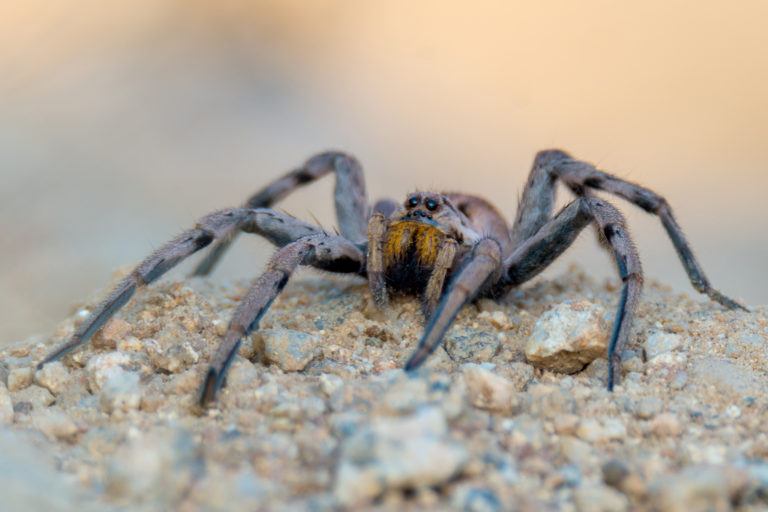
In the Kingdom of Ish, spiders may not reign supreme, but they definitely hold high office. Wolf spiders (a.k.a. ground spiders or hunting spiders), being big, hairy, and nasty, are no exception. They’re most likely the ones patrolling the outer walls, hunting for anything that moves. There are more than 2,000 species of wolf spider that make up the family Lycosidae. It just so happens that the “lyco” part of the word is Greek for wolf. Since they are hunters, wolf spiders rarely build webs. At most, they will line a hidey-hole with silk. Two more interesting tidbits: 1) Female wolf spiders carry their egg sacs on their abdomens until the eggs hatch; 2) once the eggs do hatch, all of the babies stay on the mother’s abdomen for several weeks for protection. Ish.
Wolf spiders, because they’re found absolutely everywhere, are probably the most widely known and recognized spider in the U.S. Surprisingly though, they’re often mistaken for brown recluse spiders. The two are actually pretty easy to tell apart. Check to the right for wolf spider identification. Only because I feel obligated, I must say that wolf spiders (however revolting) are actually quite beneficial. They are amazing hunters and do a darn fine job of keeping insect populations in check. In early autumn, when temps start to fall, is when they are most likely to be found indoors. Not only are they looking for a warmer place to hang, so is much of their prey. So, if you do find one in the house, bear in mind while you’re squishing it that it ain’t there to hunt you. It’s got smaller fish to fry. However, if you’re anything like me, you simply don’t give crap why it’s there; you just want it gone. I’ll tell you how to make your home and yard inhospitable for wolf spiders.
Wolf Spider Identification
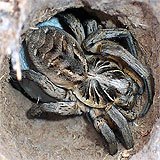
- Range in size from ¼ inch to over 2 inches
- Normally mottled gray or brown
- Usually have a lighter stripe running down the center of the cephalothorax (head)
- Hairy, stocky legs,
- Three sets of eyes (four small on bottom, two large in middle, two medium on top)
Wolf Spider Bite Symptoms
- Pain at bite site
- Possible torn skin
- Redness
- Swelling
- Itching
Best Wolf Spider Control Methods
Take down the welcome sign (Part 1).
The best way to keep wolf spiders outside is to close off access to the inside. Start by patching holes in screens and applying weather stripping to all the windows and doors. Door sweeps are a good idea too. Next, get yourself to the hardware store and buy some outdoor sealant and a caulking gun. Once procured, walk very slowly around the outside of your home and fill in any cracks/holes you can see. Look carefully around all electrical wires, cables, and plumbing.
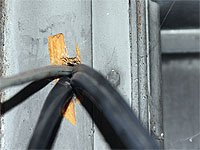
Take down the welcome sign (Part 2).
After you’re done sealing from the outside, do the same on the inside. Start in your basement or crawlspace by looking for any cracks or holes that might need filling. Look for the same wires, cables, and plumbing that you found outside along with anything else that might not have been visible to you from out there. Also look for cracks or openings around windows. Once the basement is done, work your way up. Once you hit the attic, make sure there are good tight screens around any vents.
Do what you can to make the area outside your home uninviting to wolf spiders.
Start by clearing vegetation away from your house. This includes bushes, hedges, English ivy , grasses, or any other plant you might have right up against the house. If there are rock, wood, or lumber piles, move them as far from the house as possible. Discontinue use of outdoor lighting. It attracts tasty little insects for wolf spiders to eat. If you would like to continue using outdoor lighting, switch to either yellow or sodium vapor lights. The number of bugs for those alternatives is significantly less.
Keep a clean house.
If there isn’t junk lying all over hell it’s much easier to get rid of wolf spiders. Go through the entire house and start picking things up and getting rid of things you don’t need. The more stuff lying around, the more spots for wolf spiders to hide under. Remove piles of laundry, magazines, newspapers, boxes, etc. Keep the dishes clean. Sweep, mop, and vacuum regularly. By not leaving messes and little bits of food around, you help yourself to avoid luring in other critters that wolf spiders like to eat.

A-hunting we will go.
Instead of sitting around waiting for wolf spider bites, take the initiative and get them before they get you. This is creepy, and the mere thought of it makes me shiver, but it’s kinda cool, too. Wait until nightfall, grab a flashlight, and start shining it in places where wolf spiders might hide. Wolf spiders, behind their nasty little eyes, have a layer of reflective cells called tapetum lucidum. While these help them to see at night, they also help us to find them. When the flashlight hits their eyes, the tapetum lucidum reflect the light back and make their eyes shine brightly.
Pesticides to Help Get Rid of Wolf Spiders
Yes, wolf spiders bite. However, they only do so if they are threatened and feel they have to. Luckily, while wolf spiders are venomous, a wolf spider bite is relatively harmless. Regardless of this knowledge, I for one still do not want to suffer a wolf spider bite. It hurts, it swells, and it’s itchy. So, if you wanna get them before they get you, you’re in luck. There are pesticides galore for wolf spider control that’ll kill ’em dead and keep more from coming in. Look for pesticides containing one or more of these active ingredients: deltamethrin (Delta Dust Insecticide which you can get at Amazon, Suspend SC), pyrethrin (565 Plus XLO), cypermethrin (CB Air Devil HPX, Cynoff EC, Cynoff WP, Demon WP), lambda-cyhalothrin (Demand CS), or bifenthrin (Talstar P). Just make certain to read all directions, safety precautions, and application instructions before use. Some of these are for direct spraying, some are residual, some are for use indoors, some only for outdoors, and some are even good for both. And always remember those vacuum cleaners, boots, and good sticks are indispensable tools for dispatching wolf spiders.
Best Natural Wolf Spider Control Methods
Get a cat.
True, you will then have to sift poo out of little bits of clay, but we all know cats are extraordinarily curious, and they’re great little hunters. Anything moving across the floor is fair game for them.
Lay down spider traps.
Spider traps are nothing more than little bits of card paper with some super sticky wolf spider catching goo smeared on ’em. They work great for catching spiders and anything else that happens to wander across them. Place them along floorboards and out of the reach of pets and kids.
Essentria G Granular Insecticide from EcoExempt Company is an organic, plant-based (Hexa-Hydroxyl) insecticide.
It is a ready-to-use dust that is pet-safe and works well to kill spiders and other household pests. It’s kind of expensive, but you can find a 25lb bag of this powder at Amazon.