Quick fix? Seal the hole.
Plug the entrance to the carpenter bees' nest with caulk or wood putty in the middle of the night. Carpenter bees don't try to burrow out of their galleries if they get trapped inside. Weird, right?
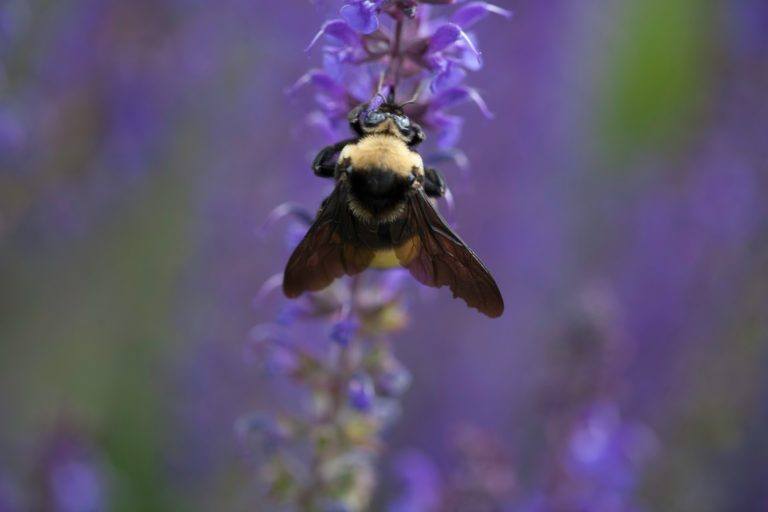
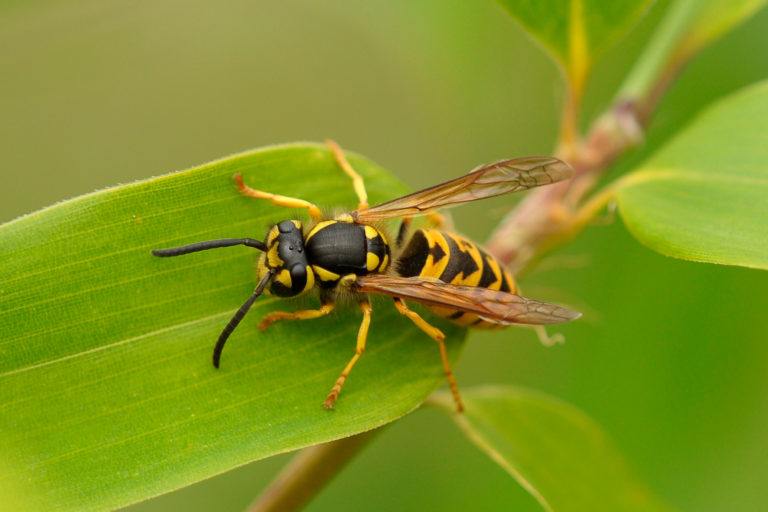
I sit outside a lot when I'm writing, or thinking about a new design, or pondering how to approach a certain article, and more often than not I cross paths with bumble bees. Our porch is surrounded by wild roses. Now, bumble bees have always interested me because nobody really knows much about them—no one I know, anyway. Turns out, they may not have been bumble bees at all. If you see a bumble bee that has a predominantly black abdomen, it may in fact be a carpenter bee. Carpenter bees are very similar to bumble bees, in appearance, and much larger than your typical honey bee. The most noticeable difference is that bumble bees have black abdomens covered with yellow hairs, and carpenter bees do not. The bee to the right in the image above is the one who will eat your house.
So, you have to wonder how long you've been noticing carpenter bees instead of actual Bumble Bees. A carpenter bee infestation is usually indicated by mounds of saw dust on the ground below an awning, or yellowish-brown feces that tend to accumulate on the walls near a nest, or maybe even constant bombardment by a noisy lot of bees that don't bother to sting you. Sometimes a serious Carpenter bee infestation is noticed because the wood they've infested is pocked with holes from their burrowing and their predator's attempts to eat them. Either way, below are some practical advice about how to get rid of carpenter bees.
Plug the entrance to the carpenter bees' nest with caulk or wood putty in the middle of the night. Carpenter bees don't try to burrow out of their galleries if they get trapped inside. Weird, right?
If you want to get rid of carpenter bees without using insecticide you may want to try plugging the entrances with caulk or putty. Now you're thinking, "but won't they try to burrow their way out?" The answer is no. For whatever reason, carpenter bees will not try to get out of the nest if they're trapped inside. So, a lot of people simply caulk or putty the entrances to the carpenter bee galleries and then paint over them. It'll save you money and time.
Another way to get rid of carpenter bees without using insecticide is to agitate and vacuum them out. This can only be accomplished if the nest is relatively new, and only in the early evening when the bees have returned to the nest and are relatively slow. A new colony will sometimes consist of only 20 or so bees, with one queen. If you notice that the colony is relatively small, you may want to consider waiting outside of the nest with a vacuum cleaner while poking the nest with a stick.
Any bee killer such as those offered by Raid can be used to get rid of carpenter bees. This is obviously the traditional method of carpenter bee control, and like any other bee infestation you should take steps to ensure that you are properly dressed and make certain that it's late enough in the evening to get all of the bees. Once you are sure all or most of the bees are in the nest, simply pull out your bee killer, spray a good bit into the nest, and wait to see if any bees come out. Go ahead and do this twice, just to make sure.
Once you have killed the bees, make sure you keep them away by replacing the wood or covering the damage with putty. If the bees haven't done too much damage and you're not going to spend any money on timber replacement, cover the entrances to the galleries with putty so other bees don't decide to take up residence there. Otherwise, if you have the money, it might be a good idea to replace any timber the carpenter bees have damaged—and take the next piece of advice seriously.
To make sure carpenter bees don't invade the outside of your home again, either install vinyl siding or have your home painted regularly. Vinyl siding (or any other non-wood siding) really is the only way you're going to ensure that carpenter bees don't damage your home. Of course, there are the purists among us who will not stand for such nonsense. To those purists I say: go ahead and use wood to side your house, but you better be darn well certain you keep the paint is kept up—wood stain won't stop carpenter bees.
Carpenter bees are rarely a serious problem, and they rarely damage a structure to the point where a massive renovation is required. They're not termites, that's for sure. But—and here's the big "but"—it does happen, and if it does happen you really have no choice but to call a professional exterminator with experience in controlling and exterminating carpenter bees. Again, this should only be done if carpenter bee damage is extensive.
Otherwise, there should be no need to call an exterminator to rid your home of carpenter bees. A can of Raid should be all you need to take care of the problem, and more often than not it doesn't even require that.